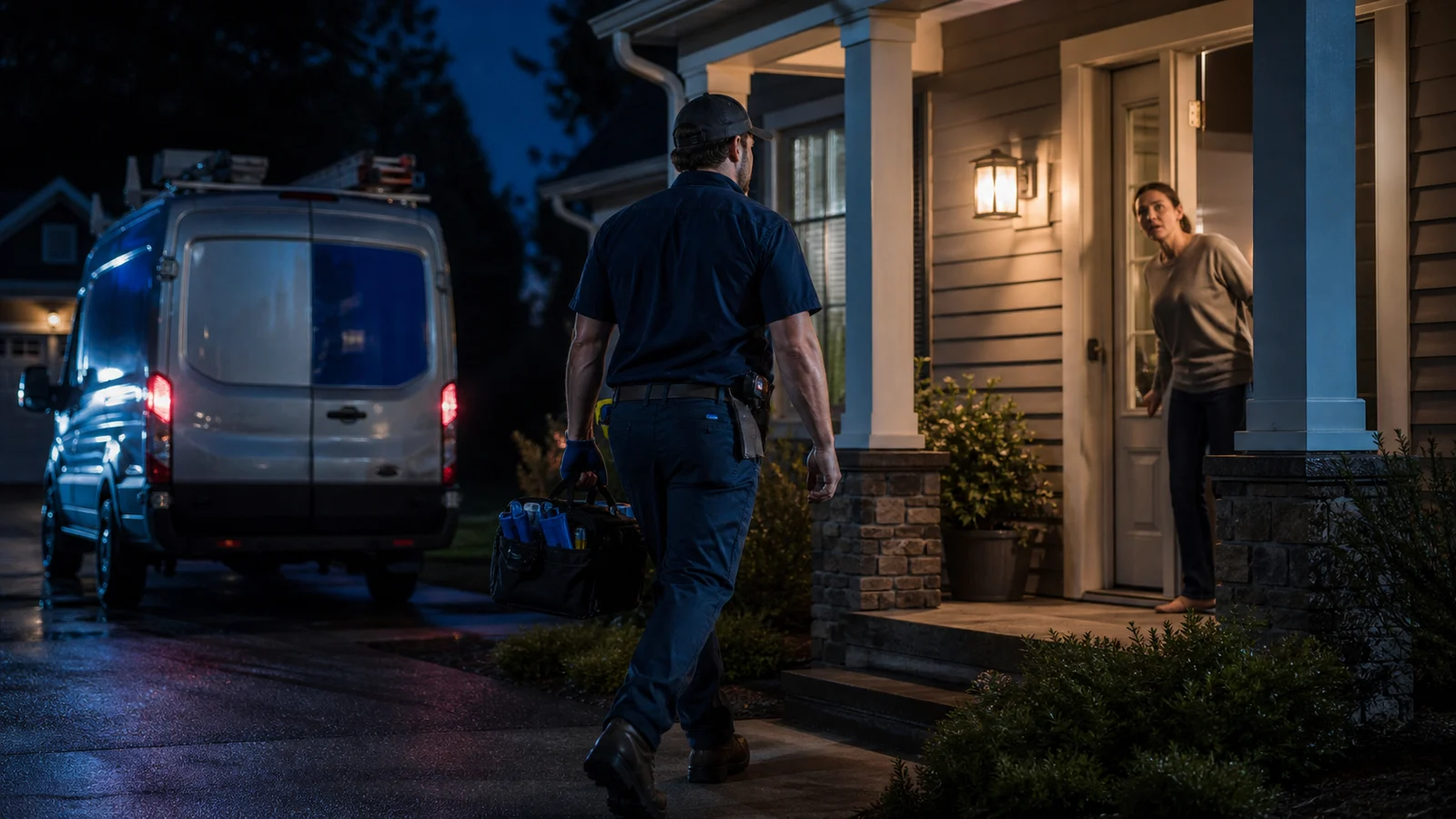
At 11:43 p.m., a homeowner hears water running somewhere behind the basement wall. They don't know which pipe failed, whether the damage is spreading, or who is willing to come out that late. They call the first plumber, get voicemail, and try the next number.
The contractor's problem starts before a technician ever reaches the driveway. Someone has to answer, figure out what kind of help the caller needs, separate a life-safety emergency from an urgent service request, and give the call a next step. After hours, there isn't a front desk nearby to fill in the gaps.
A good after-hours call flow doesn't make an AI receptionist the technician, dispatcher, and emergency operator. It gives the receptionist a narrow job: ask the company's approved questions, follow its routing rules, and leave the on-call team with enough context to act.
Three Lanes After Dark
Every after-hours call should enter one of three lanes. The labels can change, but the operating decision needs to be clear before the phone rings.
| Call Lane | What the Caller Hears | What Happens Next | | --- | --- | --- | | Life-safety concern | A brief instruction to contact emergency services or the appropriate utility from a safe location | No diagnosis or service promise; an urgent record can still be created if company policy allows | | Urgent service request | A few approved intake questions and a clear explanation of the transfer attempt | Transfer to the on-call person, with a defined fallback if nobody answers | | Routine request | Confirmation that the request was captured and when follow-up should occur | Create a callback or appointment request for the next service window |
That first lane needs a hard boundary. Ready.gov tells people to leave the home and call 9-1-1 or the fire department when they can't reach someone who needs help during a fire.<sup>1</sup> Its power-outage guidance also warns that using a generator indoors or heating a home with a gas stove can create carbon-monoxide and fire risks.<sup>2</sup>
An answering workflow shouldn't improvise around those situations. The safest script is the one the contractor approved with its own safety and legal advisers: recognize the trigger language, tell the caller to contact the proper emergency resource, and stop trying to troubleshoot.
Urgency Needs Company Rules
“Emergency” means different things to different callers. A dripping faucet can feel urgent at midnight. So can a warm bedroom, a tripped breaker, or a strange noise from the furnace. The receptionist shouldn't settle the argument. It should ask questions that map the caller's words to the contractor's rules.
An HVAC company might distinguish a routine no-cooling request from a call involving a vulnerable occupant. A plumbing company may route active water damage differently from a slow drain. An electrical contractor may have a specific safety script for smoke, fire, sparking, or a burning smell before any service intake continues.
Those examples aren't universal instructions. They're prompts for the company to define its own lanes. The rule should live in the call flow, not in somebody's memory at 2 a.m.
This is where the voicemail comparison for contractors leaves off. A structured intake is useful, but after-hours coverage also needs a decision: wake the on-call person, create a callback, or send the caller to the right emergency resource.
The After-Hours Record
The on-call technician doesn't need a transcript dumped into a text message. They need the facts that change the next decision.
For most HVAC, plumbing, and electrical teams, the after-hours record should capture no more than five things:
- The caller's name and best callback number
- The service address or ZIP code
- The trade and problem in the caller's own words
- The urgency lane selected by the company's approved rules
- The next step the caller was given
That final field is easy to miss. If the caller heard “someone will call you back within 20 minutes,” the on-call person needs to know that promise was made. If the caller was told the request would be reviewed when the office opens, the morning team needs the same record.
The point isn't to collect every detail a technician might ask on site. It's to make the next action obvious without forcing the caller to repeat the whole story.
A Transfer Is An Attempt
After-hours workflows often look tidy on paper: urgent call, ring the on-call technician, job done. Phones are less cooperative.
Twilio defines call routing as sending calls to a queue using predetermined criteria.<sup>3</sup> Time of day, service area, call reason, and urgency can all become criteria in a contractor's routing plan. Yet the route still needs to account for a busy line, a failed connection, or a technician who can't pick up.
Twilio's <Dial> documentation exposes outcomes such as busy, no-answer, failed, and canceled after a transfer attempt.<sup>4</sup> That distinction is operational gold. “We tried a transfer” isn't the same as “a person answered.”
A useful fallback should answer three questions: what the caller hears when the transfer fails, where the captured intake goes, and who owns the callback by what time.
Sonira's call-routing guide for service businesses covers the wider transfer structure. For after-hours calls, the rule is simple: never let a failed handoff erase the work the receptionist already did.
Don't Wake The Technician For Everything
An after-hours system can fail in the other direction too. If every caller is marked urgent, the on-call technician becomes a second receptionist with worse sleep.
Routine estimate requests, maintenance questions, warranty inquiries, and scheduling changes often need a clean callback rather than a midnight transfer. The caller should still get an answer and a believable next step. The technician should get interrupted only when the company's rules say the call belongs with them.
That balance protects the caller and the crew. It also gives the office a better morning queue. Instead of a voicemail box full of half-stories, the team sees which requests were escalated, which transfers failed, and which callbacks are waiting.
Miss The Transfer On Purpose
Before an after-hours flow handles real customers, test the awkward paths. Call from an unfamiliar number. Use an address outside the service area. Describe an urgent plumbing problem, then a routine HVAC estimate. Let the on-call phone ring without answering.
The test should confirm that:
- life-safety language triggers the approved boundary script
- service-area questions don't turn into guesses
- urgent requests reach the correct transfer target
- failed transfers preserve the intake and explain the fallback
- routine calls arrive in the right morning queue
Listen to the whole exchange. A technically correct route can still sound cold, repetitive, or confusing. The Sonira home-services demo gives contractors a place to hear a configured intake flow before they put one in front of customers.
One Night, One Call Path
Start with the after-hours call your company sees most often. For a plumber, it might be an active leak. For an HVAC company, it could be a no-cooling call. For an electrician, it may be a loss-of-power request that needs a clear safety boundary before scheduling begins.
Write the three lanes. Choose the on-call target. Decide what happens when the target doesn't answer. Then run the test until the caller, technician, and morning dispatcher all receive the next step they expected.
If your current after-hours plan is “leave a message and hope someone notices,” map one narrower path through the home-services phone coverage workflow. Sonira can help test the intake, transfer, and fallback before you rebuild the rest of the line.